Evidence for Better Disinfection Decisions
Regulatory documents, organism-specific efficacy, research, and operational evidence in one place.
Start with EraDOCator-60 product facts and current source documents. Then see how CDC and FDA pathogen activity, produce-safety events, peer-reviewed research, and operational evidence relate to your facility or food system without expanding the EPA-accepted label claim. Procurement teams, infection prevention leaders, and operators can review the evidence pathway from regulatory documentation to implementation decisions.
Start with verified facts. Connect evidence to decisions.
Product identity and label-based efficacy come first. Research, outbreak context, operational experience, and implementation evidence provide additional context for Infection Prevention, Procurement, Operations, Administration, Safety, and other decision-makers.
EraDOCator-60 Product & Regulatory Review
Use this section for product identity, label-based contact times, and direct source-document access.
Product identity
- Distributor productEraDOCator-60
- EPA Reg. No.54289-4-102813
- EPA primary registration54289-4
- Active chemistryPeracetic acid + hydrogen peroxide chemistry
- Primary label acceptedFebruary 5, 2026
- Healthcare useHard, non-porous surface disinfection in hospitals and health care facilities
Label-based contact times
1 minute. The February 5, 2026 EPA-accepted primary label lists multiple bacteria, viruses, viral surrogates, and fungi with a 1-minute contact time. High-priority examples include Salmonella enterica ATCC 10708, Salmonella enterica serovar Typhimurium ATCC 13311, Listeria monocytogenes ATCC 19111, E. coli O157:H7 ATCC 35150, MRSA ATCC 33592, CA-MRSA USA300, Pseudomonas aeruginosa ATCC 15442, Influenza A H3N2, RSV, Human Coronavirus 229E, Rhinovirus Type 37, Rotavirus, and a label-listed Norovirus surrogate claim.
3 minutes. The current label specifies a 3-minute contact time for Streptococcus pneumoniae ATCC 6304 and vancomycin-resistant Enterococcus faecalis, VRE, ATCC 51575.
4 minutes. The current EPA-accepted primary label lists the three organisms below with a 4-minute wet contact time. Use the current label for preparation and concentration requirements.
4-minute contact time
EPA List K
4-minute contact time
EPA List P
4-minute contact time
Current EPA primary label
Quick source check
Use EraDOCator-60 product documentation together with primary EPA Reg. No. 54289-4, the current accepted label, and the applicable EPA organism lists.
Current Pathogen & Outbreak Watch
Current public-health events can help facilities identify where label-listed organisms are operationally relevant. This section keeps the outbreak organism separate from the exact EPA label organism or surrogate.
Salmonella outbreaks and produce recalls
Current public-health signal: As of September 10, FDA lists several active Salmonella investigations. A new Salmonella Bovismorbificans outbreak linked to recalled Evergreen Fresh Sprouts broccoli sprouts includes 22 illnesses across 4 states, 2 hospitalizations, and no deaths. FDA also reports 109 Salmonella Newport illnesses with the source not yet identified, 43 Salmonella I 4,[5],12:i:- illnesses with the source not yet identified, and an ongoing alfalfa-sprout outbreak involving Salmonella Agona together with multiple STEC strains.
EraDOCate label relationship: The accepted label lists Salmonella enterica ATCC 10708 and Salmonella enterica serovar Typhimurium ATCC 13311 at a 1-minute contact time on hard, non-porous surfaces at the standard healthcare dilution.
Safe interpretation: These are Salmonella-relevant hard-surface label claims. Salmonella Bovismorbificans, Newport, I 4,[5],12:i:-, Agona, Javiana, and other outbreak serovars should not be represented as the exact EPA-tested label strains unless the accepted label specifically identifies them.
Listeria monocytogenes
Current public-health signal: FDA lists an active Listeria monocytogenes investigation with 9 reported cases and the implicated product not yet identified.
EraDOCate label relationship: Listeria monocytogenes ATCC 19111 is listed at a 1-minute contact time for hard, non-porous surface disinfection at the standard healthcare dilution.
Safe interpretation: The organism is an exact species match. The current outbreak should not be represented as an exact ATCC 19111 strain match unless public-health data establish that identity.
Current produce-associated E. coli investigations
Current public-health signal: The ongoing alfalfa-sprout outbreak includes STEC O26:H11, O103:H25, and O168:H8 together with Salmonella Agona. FDA reports 55 total illnesses and 4 hospitalizations. A separate ongoing outbreak linked to frozen organic blueberries involves E. coli O145:H28, with 17 illnesses, 6 hospitalizations, and no deaths as of the September 3 FDA update.
EraDOCate label relationship: The accepted label lists E. coli O157:H7 ATCC 35150 at a 1-minute contact time on hard, non-porous surfaces.
Safe interpretation: Do not convert the O157:H7 hard-surface claim into a claim against O26:H11, O103:H25, O168:H8, O145:H28, or another unlisted serotype.
Candida auris remains a healthcare priority
Current public-health signal: CDC reports 6,304 clinical C. auris cases in 2024 and notes that cases continue to rise nationally, with ongoing transmission in some geographic areas.
EraDOCate label relationship: Candida auris CDC AR-0385 is listed under the current 4-minute label-listed protocol. Primary EPA Reg. No. 54289-4 also appears on EPA List P. Use the current EPA-accepted label for preparation and concentration requirements.
Safe interpretation: Market the accepted C. auris claim and 4-minute protocol. Do not imply that every circulating clinical isolate has been individually tested.
Produce Safety: What 2026 Outbreaks, FDA Guidance & PAA Research Are Showing
Use current outbreaks to identify vulnerability in the food system. Use FDA guidance to frame preventive controls. Use peer-reviewed PAA research to understand the broader science. Use the current EPA label to determine exactly what EraDOCator-60 claims and directions apply.
Current Produce Outbreak Signal
FDA reports a new Salmonella Bovismorbificans outbreak linked to broccoli sprouts with 22 illnesses, 2 hospitalizations, and no deaths; an ongoing alfalfa-sprout outbreak involving multiple STEC strains and Salmonella Agona with 55 illnesses and 4 hospitalizations; an ongoing E. coli O145:H28 frozen-blueberry outbreak with 17 illnesses and 6 hospitalizations; and 11,458 Cyclospora illnesses, 495 hospitalizations, and 2 deaths in the iceberg-lettuce outbreak as of August 27. These counts describe public-health events, not EraDOCator-60 efficacy.
Fresh-Cut Produce Gets New 2026 Guidance
FDA finalized guidance on August 11, 2026 for ready-to-eat fresh-cut produce processors. It addresses CGMPs, hazard analysis, preventive controls, and control measures for washing cut produce. Fresh-cut produce often has no later kill step, which increases the importance of process control and prevention of contamination.
Open FDA GuidanceWhat the EraDOCator-60 Label Adds
The current primary label includes separate commercial fruit-and-vegetable process-water, raw post-harvest produce, processed-produce, food-contact sanitizing, and hard-surface disinfection directions. Produce-treatment claims remain separate from public-health outbreak-pathogen claims.
New 2026 Produce & PAA Evidence
80 ppm PAA on Collard Greens & Kale
A UC Davis study evaluated 80 ppm PAA on collard greens and kale. PAA produced the largest reductions among the acid-based washes tested, including about 1.0 to 1.2 log reductions in native bacteria, 1.2 to 1.4 log reductions in fungi, and about 1.5 to 2.3 log reductions in Enterococcus faecium, used as a pathogen surrogate. The study used a 5-minute soak and 15-second rinse, so its results do not establish an EraDOCator-60 efficacy claim.
Open PubMedBiofilm Performance Depends on the Surface
A USDA-linked study tested PAA against E. coli O157:H7 and Listeria monocytogenes biofilms on stainless steel, PTFE, and EPDM under dynamic-flow conditions. Performance varied by surface, shear conditions, and exposure time. EPDM was consistently harder to clean. The study supports attention to equipment design, gaskets, high-shear zones, pre-cleaning, and verification.
Open PubMedSublethal PAA Stress Deserves Attention
A 2026 experimental study found PAA exposure induced persistent small-colony variants in Listeria monocytogenes with metabolic dormancy and increased biofilm formation under the study conditions. This finding reinforces correct concentration, full labeled contact time, cleaning before sanitizing or disinfecting, and process verification. It does not negate EPA-accepted label claims.
Open PubMedTwo Sprout Outbreaks Reinforce Cross-Contamination Control
FDA is investigating separate 2026 sprout outbreaks. Salmonella Bovismorbificans has been linked to recalled Evergreen Fresh Sprouts broccoli sprouts. A separate alfalfa-sprout investigation involves STEC O26:H11, O103:H25, O168:H8 and Salmonella Agona. FDA advises consumers, restaurants, retailers, and foodservice customers to carefully clean and sanitize surfaces or containers touched by recalled sprouts.
Open September FDA AdvisorySanitation Is One Control Point
Current evidence supports a systems approach. Water, produce, equipment, food-contact surfaces, concentration, contact time, temperature, holding time, cleaning, training, and cross-contamination controls all affect performance.
Explore Produce & Post-HarvestResearch Does Not Expand the Label
Neither current outbreak reports nor broader PAA studies create EraDOCator-60 claims against STEC O26:H11, O103:H25, O168:H8, E. coli O145:H28, Salmonella Bovismorbificans, Salmonella Newport, Salmonella Agona, Salmonella Javiana, Cyclospora, or biofilms. Use the current EPA label for organism-specific public-health claims and directions for use.
Verify Regulatory DocumentsHealthcare Infection Prevention: The Operational Challenge
An October 2025 review from Infection Control Consulting Services, ICCS, identified five recurring pressures for healthcare facilities: emerging pathogens and antimicrobial resistance, infection-prevention staffing shortages, surveillance and reporting burden, budget pressure, and inconsistent compliance driven by human factors.
Emerging Pathogens & AMR
ICCS highlights the need to keep infection-prevention protocols current as pathogen threats and antimicrobial resistance change. For a disinfectant review, start with the current EPA label and organism-specific directions.
Staffing & Oversight
Staffing shortages can reduce infection-prevention oversight and consistency. A practical environmental-cleaning program needs clear ownership, training, frontline feedback, and repeatable workflows.
Surveillance & Reporting
ICCS describes growing reporting and data burden. Facilities need measurable processes that help leaders evaluate implementation, identify gaps, and prepare for surveys and audits.
Budget & Value
ICCS notes that infection-prevention investments may stall when leaders cannot see the financial case. Product evaluation should include workflow, training, dispensing, standardization, implementation burden, and measurable outcomes.
Compliance & Human Factors
Written policies alone do not guarantee consistent execution. Environmental cleaning depends on how well the workflow fits the people performing it.
EraDOCate Decision Lens
Evaluate label-based efficacy first. Then compare workflow, training, dispensing, measurement, frontline experience, surface requirements, and implementation ownership. The current EPA-approved label remains the authority for EraDOCator-60 claims and directions for use.
From Scientific Evidence to Operational Decisions
Healthcare and institutional buyers evaluate disinfectant programs through multiple evidence layers. EraDOCate separates EPA label claims, peer-reviewed research, outbreak information, and real-world implementation experience.
Regulatory Evidence
EPA registration, label-listed organisms, contact times, and source documentation define approved product claims.
Scientific Evidence
Peer-reviewed research provides additional understanding of chemistry, pathogen behavior, application methods, and environmental considerations.
Implementation Evidence
Operational testing, verification processes, training, and facility experience support adoption decisions.
What Decision-Makers Need to Understand
Different teams look at the same product from different angles. The strongest review connects efficacy, workflow, training, purchasing, implementation, and frontline experience.
Published oncology-unit evidence: enhanced environmental cleaning matters.
A University of Pennsylvania study on two oncology units evaluated a multimodal environmental-cleaning intervention that included ATP bioluminescence monitoring with real-time feedback to EVS staff plus UV disinfection after terminal cleaning. Adjusted analysis found an incidence rate ratio of 0.72 for C. difficile compared with control units, corresponding to approximately 28% lower incidence (95% CI 0.53–0.97; P=.03). This was independent research and did not evaluate EraDOCate.
Havenwood Heritage Heights: real-world facility experience.
Havenwood Heritage Heights reported outbreak duration decreasing from 31 days in 2023 to 14 days in 2025. EraDOCate adoption began in June 2024, with full-facility adoption in 2025. These are facility-reported observational results. Multiple operational and clinical factors may contribute to outbreak duration, this is not an EPA efficacy claim, and the same result is not guaranteed at another facility.
How Buyers Can Use the Evidence
Use the evidence to compare EraDOCator-60 with the facility's current program across efficacy, workflow, purchasing, implementation, surface requirements, and other priorities that matter to the organization.
Infection Prevention
Review organism-specific efficacy, concentration, contact time, surface requirements, and how the protocol fits patient-care or resident-care workflows.
Procurement
Review product standardization, dispensing, documentation, ordering, training needs, surface compatibility, and total program complexity.
Administration & Operations
Review implementation ownership, staff adoption, turnover workflow, training, process metrics, and whether the program can scale.
EPA Design for the Environment Status
EraDOCate is pursuing EPA Design for the Environment, DfE, certification for eligible products. Certification is pending EPA review and has not yet been granted.
This status can be included in environmental or procurement review where it is relevant.
Evidence Beyond Efficacy
Some reviews also consider worker exposure, application method, residue, laundry, wastewater, food systems, produce handling, and broader stewardship.
Air & application
Review how spraying, wiping, ventilation, frequency, and other application factors shape routine use.
Surfaces & residue
Review product-specific residue information and how repeated use relates to surfaces and contact pathways.
Drains & wastewater
Review environmental-fate and wastewater research when downstream stewardship is part of the purchasing decision.
Textiles & laundry
Review laundry and textile evidence when reusable fabrics are part of the operating workflow.
Land & plant pathways
Review environmental research when land, biosolids, agriculture, or community stewardship is relevant.
One Health & AMR
Review animal, aquatic, and antimicrobial-resistance research where those issues matter to the organization.
Copley Hospital Research · EraDOCator-60 in an Acute-Care Setting
A published randomized study at Copley Hospital in Morristown, Vermont evaluated the effectiveness of EraDOCator-60 in a working healthcare environment. Researchers measured ATP contamination before and after a 1-minute application across four hospital areas and reported substantial reductions in measurable surface contamination.
Published study
Can Eradocator-60 Decrease MDRs and HAIs? An Evaluation of the Efficacy of Eradocator-60 in a Randomized Clinical Trial in a Community Hospital
- AuthorsMartin Johns · Matthew Machata · Stephanie Liseno · Joseph del Castillo
- JournalNew Advances in Brain & Critical Care
- Citation2023 · Volume 4, Issue 1 · Pages 19-24
- PublishedJune 14, 2023
- Study siteCopley Hospital · Morristown, Vermont
- MeasurementCharm ATP analyzer · Relative Light Units (RLUs)
Study question and design
The investigators evaluated whether EraDOCator-60 could rapidly reduce environmental contamination in a healthcare setting, a question the paper framed within the broader challenge of multidrug-resistant organisms and healthcare-associated infections. Separate hospital areas were cleaned and disinfected with EraDOCator-60, and ATP was measured before treatment and again after the reported 1-minute dwell time.
What the Copley study adds to the evidence story
The publication gives EraDOCate direct hospital-based research in a real acute-care environment. The authors reported that EraDOCator-60 reduced measured contamination on all evaluated surfaces to 0 RLU after the reported 1-minute dwell time under the study conditions. That provides a measurable environmental-cleaning result directly relevant to the broader goal of reducing reservoirs that can contribute to infection transmission.
WPI E-60 Research · Disinfection Performance & Biological Tolerance
Worcester Polytechnic Institute's 2025 Summer Research Showcase included a controlled laboratory study of E-60 that looked beyond surface disinfection alone. Researchers evaluated ATP-measured disinfection performance, mammalian-cell response, and C. elegans response across experimental concentrations, including a comparison with bleach.
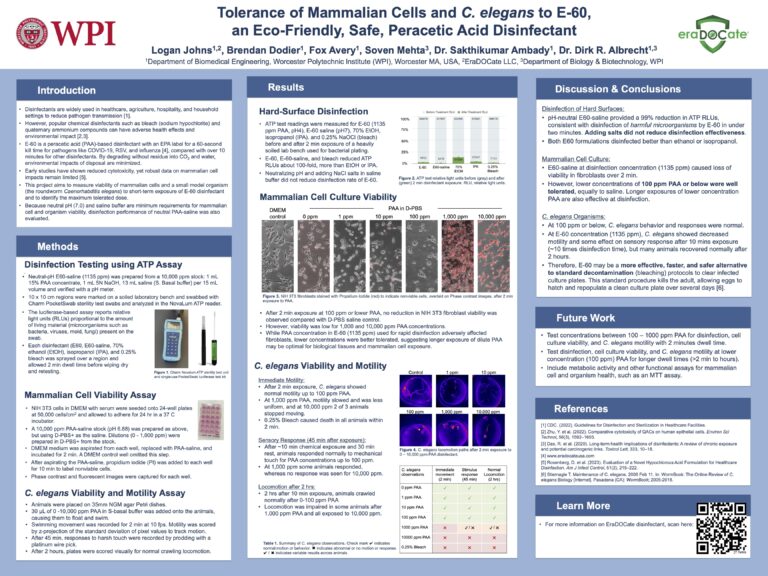
Poster #89 · 2025 WPI Summer Research Showcase
Published poster title: “Tolerance of Mammalian Cells and C. elegans to E-60, an Eco-Friendly, Safe, Peracetic Acid Disinfectant.”
- AuthorsFox Avery · Brendan Dodier · Logan Johns · Soven Mehta
- ProgramIndependent summer research
- DepartmentBiomedical Engineering
- AdvisorsDr. Dirk R. Albrecht · Dr. Sakthikumar Ambady
- Study modelsATP surface testing · NIH3T3 fibroblasts · Caenorhabditis elegans
What the WPI study adds to the evidence story
The WPI research is valuable because it looked at two questions at the same time: can E-60 maintain measurable disinfection performance under the experimental formulation, and how do biological models respond across different exposure concentrations? That gives the EraDOCate evidence library a research perspective that is different from the hospital ATP study and from broader published literature.
Evidence Library
Start with regulatory and infection-prevention sources, then explore occupational, environmental, operational, and policy references as needed.
EraDOCator-60 Regulatory Documents
Product identity, current label resources, supplemental-distribution documentation, and EPA organism-list cross-checks.
Current EPA Label — Primary Reg. 54289-4
Official EPA-hosted primary label for EPA Reg. No. 54289-4. This is the primary regulatory source for the 4-minute C. difficile, C. auris, and Poliovirus Type 1 directions used in the verification section above.
EPA Supplemental Distribution
EPA explains why a three-part registration such as 54289-4-102813 traces back to primary registration 54289-4 and how supplemental distributor products relate to the primary product.
EraDOCate Evidence & Insights
EraDOCate regulatory, scientific, outbreak, operational, and educational resources in the current evidence hub.
EraDOCate Videos
Video content for product education, implementation conversations, and training support.
Comprehensive Guide
Operational guidance and multilingual training support for EraDOCate workflows.
CDC C. auris Guidance
Environmental cleaning and C. auris readiness.
EPA List P
Registered products with claims against Candida auris.
EPA List K
Registered products with claims against C. diff spores.
EPA List H: MRSA & VRE
EPA cross-check for primary Reg. No. 54289-4 showing a 1-minute MRSA contact time and 3-minute VRE contact time.
EPA List S: Bloodborne Pathogens
EPA cross-check for primary Reg. No. 54289-4 showing 1-minute contact times for HIV, Hepatitis B, and Hepatitis C.
FDA Active Foodborne Outbreak Investigations
Current FDA investigations, traceback activity, inspections, sampling, advisories, and recalls involving Salmonella, Listeria, E. coli, Cyclospora, and other pathogens.
Fresh Produce & Post-Harvest
EraDOCate's dedicated resource for current produce-safety context, label-supported produce/process-water workflows, community value, and measurable implementation design.
Fresh Produce Antimicrobial Wash Study
2025 peer-reviewed study evaluating 80 mg/L PAA and other antimicrobial washes on cucumbers, broccoli, and lettuce, including cross-contamination experiments.
PAA and Pecan Conditioning Water
2025 Food Control study evaluating 30 and 90 ppm PAA for Salmonella reduction and cross-contamination control during in-shell pecan conditioning.
PAA in Cut Salads
2025 study showing that 80 ppm PAA had only a temporary, relatively weak effect under the tested conditions and did not improve shelf life.
EPA Residue Methods
QAC and phenolic residue testing methods.
EPA Design for the Environment, DfE
EPA explains DfE certification for antimicrobial pesticide products and the review process for registrants.
UC Davis: QAC Inhalation Toxicity
UC Davis summary of mouse-model research comparing inhaled and oral QAC exposure.
EST: Aspirated QACs and Lung Injury
Peer-reviewed mouse-model study evaluating aspirated QAC exposure and lung injury.
QACs: Chemical Class of Emerging Concern
Environmental Science & Technology review covering environmental occurrence, ecological effects, human exposure, health effects, and antimicrobial resistance.
Surface Residues and Human Exposure
Study using indoor dust, bulk air, hand wipes, silicone wristbands, and urine to evaluate QAC exposure pathways in homes.
Indoor Dust and Human Urine
2026 Environmental Pollution study connecting paired indoor dust and urine samples to QAC suspect screening and exposure associations.
Wastewater, Effluent, and Biosolids
Environmental Science & Technology study analyzing 21 QACs in influent, effluent, and biosolids from 12 wastewater treatment plants from 2020 to 2023.
QACs in Textiles and Laundry Wastewater
2026 study on QAC occurrence in textiles and laundry wastewater, including migration concerns from QAC-treated reusable textiles.
QACs in Surface Water and Stormwater
New York study surveying 27 QACs in surface water, drinking water, stormwater runoff, swimming pool water, rainwater, tap water, bottled water, and lake water.
QAC Uptake in Wheat Seedlings
2026 Environmental Science & Technology study on uptake and metabolism of DTAC, DBAC, and DDAC in hydroponically grown wheat seedlings.
BAC, Fish, and Resistance Genes
Journal of Hazardous Materials study reporting that environmental concentrations of benzalkonium chloride strongly induced resistance gene profiles in fish.
NPIC QAC Fact Sheet
Balanced toxicology and proper-use context for quaternary ammonium compounds, including exposure routes and label-based use.
Nurses’ Health Study II: Disinfectants and CVD
Large prospective observational study reporting an association between frequent occupational disinfectant exposure and incident cardiovascular disease.
Disinfectants and Asthma Risk
Occupational study evaluating associations between disinfectant and cleaning-product exposure patterns and asthma.
QACs in Assisted Living
Study evaluating QAC use patterns and measured surface and dust contamination in assisted-living environments.
ICCS: Top Infection Prevention Challenges in 2025
Industry infection-prevention perspective on emerging pathogens and AMR, staffing shortages, surveillance and reporting burden, budget pressure, environmental cleaning, and human factors. Included for healthcare operational context, not as product efficacy evidence.
Hospital Room Cleaning Review
Cleaning hospital surfaces to prevent HAIs.
UPenn Oncology Units: Enhanced Environmental Cleaning & C. difficile
Published 2020 study of two oncology units. A multimodal intervention using ATP monitoring with real-time EVS feedback plus UV terminal-room disinfection was associated with an adjusted C. difficile incidence rate ratio of 0.72 versus controls, approximately 28% lower incidence. This study did not evaluate EraDOCate.
CMM: EVS Input and HAI Prevention
2026 industry reporting on EVS engagement and real-time feedback. The article cites a 25% oncology-unit C. difficile reduction as a communication example. For the underlying research result, use the published University of Pennsylvania study above.
Carling ICU Hygiene Study
Environmental hygiene intervention in ICUs.
New York S9073A
PFAS-related product disclosure and procurement trend.
Find the Evidence You Need
Different teams can use the same library for different questions.
Infection Prevention
Start with the current label, EPA organism lists, C. auris and C. difficile guidance, environmental-cleaning resources, and healthcare operational evidence such as the ICCS infection-prevention review.
EVS & Operations
Use implementation guidance, training resources, room-turn examples, PPM checks, and frontline-feedback evidence.
Procurement
Review product identity, dispensing, surface requirements, standardization opportunity, residue information, and supplier documentation.
Worker & Facility Health
Use occupational, inhalation, respiratory, cardiovascular, and exposure-pathway research for deeper health and safety review.
Stewardship & One Health
Use wastewater, textile, plant, animal, aquatic, and antimicrobial-resistance research where those topics are relevant.
Leadership
Connect efficacy, workflow, staffing, implementation, purchasing, and facility priorities into one decision.
Food Safety & Produce
Start with the current produce/process-water label directions, then use FDA outbreak investigations and peer-reviewed PAA studies for broader food-safety context, implementation planning, and community-impact questions.
Want to Review the Evidence With Us?
Bring your current products, contact times, workflow, training, dispensing approach, and priority concerns. EraDOCate can help organize the comparison around the evidence that matters to your facility.
EraDOCator-60 is an EPA-registered disinfectant, EPA Reg. No. 54289-4-102813, with labeled use in hospitals and health care facilities. Use according to the current EPA-approved label, SDS, applicable workplace safety requirements, facility policies, and equipment manufacturer instructions. EPA registration does not imply EPA endorsement.
A Review Can Focus On
- Product identity and label-based efficacy
- Organism-specific contact times
- Current workflow and training
- Dilution and dispensing
- Surface and use requirements
- Worker and facility evidence
- Stewardship priorities
- Demonstration, procurement, and implementation planning